Gupta Ananya

Touch & Tumble Tinkers
A toy for visually impaired toddlers
Touch & Tumble Tinkers offer a safe and engaging way for toddlers with low vision or partial blindness to explore and navigate their surroundings during their curious, exploratory stage.
October 2023 - November 2023 | 6 weeks
User Research
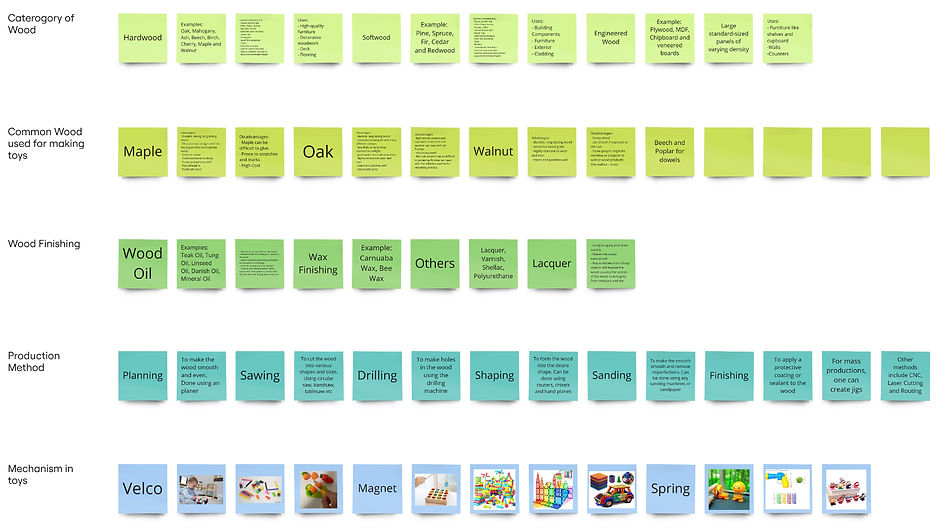
To identify user needs, I conducted primary research, including a brief study on blindness and the typical developmental milestones for 2-year-olds. I did some secondary research too. This included analysing existing toys in the market and exploring various types of play. Given the brief’s requirement to use wood, I also researched common types of wood used in toy production, wood finishing techniques, and manufacturing process.

Persona
After the interviews with two caregivers of children with blindness and based on my research, I created two personas. Primary persona represents the visually impaired toddler and a secondary persona represents the caregiver of the child.
 |  |  |
|---|
Initial Ideation
My early concepts emphasized skills such as navigation and gross motor development.
Idea 2 showed the most potential, drawing inspiration from push walkers, shopping carts, and toddler trucks. The toy aimed to teach navigation and gross motor skills. I envisioned a scooping mechanism similar to a fishing rod but had concerns about its practicality.


Form Exploration
During form exploration, I questioned the initial concept:
-
Does it need to resemble a truck or cart, or could it be simplified to a stick with wheels, like a measuring device or tennis ball collector?
-
Could it produce sounds when rolled over certain surfaces?
-
Could it feature interchangeable parts, different wheel types, or modular components?
I identified three critical stages of the final design:
-
Familiarize: Spark curiosity with blocks and detachable components.
-
Associate: Help the child associate the product with their surroundings.
-
Transition: Gradually transition to a walking stick as they approach preschool age.


Low-Fi Prototypes
Before developing the final model, I created low-fidelity prototypes to refine the mechanism, proportions, and wheel type. Lacking access to users, I used a 1:1 scale silhouette of a 2-year-old child for testing and visualization of size and proportions.
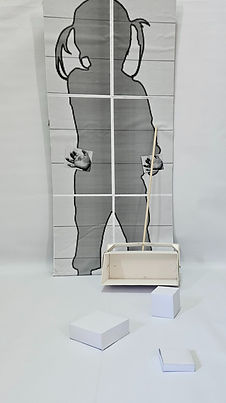
Low-Fi Prototype 1
+ Proportions of the overall prototype was just right.
- The wheels size was too small.
- The wheels did not spin freely.
- It failed to pick up any blocks.

Low-Fi Prototype 2
+ Wheels gave good controllability.
- The overall size of the prototype was too big.
- It failed to pick up any blocks.

Low-Fi Prototype 3
+ Overall size of the prototype was just right.
+ "Swept" all the blocks without any difficulties
- Without the wheels, it made an annoying sound when "sweeping" the toys.

Low-Fi Prototype 4
+ Had the best controllability among all the prototypes.
+ It gave a lot more stability while walking, running and standing.
+ Gear shaped wheels help to distinguish between different types of ground.
- Overall size of the prototype was slightly small.
Final Model
 |  |  |  |  |
|---|---|---|---|---|
 |  |  |  |  |
Design Rationale
Research revealed that toddlers with low vision or partial blindness may find it challenging to adapt to a walking stick at a young age. Touch & Tumble Tinkers facilitates a smooth transition by integrating play into the learning process. The product supports three stages: Familiarization, Association, and Transition.

Familiarize:
The child begins by identifying shapes and counting their sides. To make this activity more engaging, they can stack blocks in ascending or descending order based on the number of sides.

Associate:
As the child becomes more confident, they can use the toy to practice navigation skills. Caregivers can scatter the blocks, encouraging the child to locate them using the toy as a guide.

Transition:
The toy facilitates a gradual transition from play to practical use. As they grow more confident, they transition to using the stick independently as a walking aid, preparing them for preschool.
Touch & Tumble Tinkers Components:
1)Detachable Stick
The stick can be removed and used as a walking stick for enhanced adaptability.
2)Gear-Shaped Wheels
These provide better control and stability as the child learns to walk.
3)Magnetic Block Collection
Blocks attach to the bottom of the toy via magnets, creating a satisfying "snap" sound to signal successful collection.
4) Modular Design with Dowel Joinery
Apart from the main body, all attachments use dowel joinery, allowing future expansion into an ecosystem. This modular approach enables different wheel shapes and stick types to cater to a wider audience.
4)Materials
Body, wheels, and blocks are made of maple wood, known for it's hardness, splinter resistance, non-toxic nature, and suitability for rough play, especially for children with sensitive skin. While dowels are crafted from beech wood.
5)Finishing:
The entire product is treated with food-grade mineral oil to enhance the wood grain’s natural beauty and improve water resistance.

Magnets
Magnets
Blocks with different number of sides
Detachable Walking Stick
Gear-shaped Wheel
Main Body
Future Improvement
As mentioned earlier, caregivers will guide the child toward the blocks. To enhance the sensory experience, I could have added beads inside the blocks to provide auditory feedback. Additionally, introducing texture on one side of the block would help the child keep track of which side they started counting from.